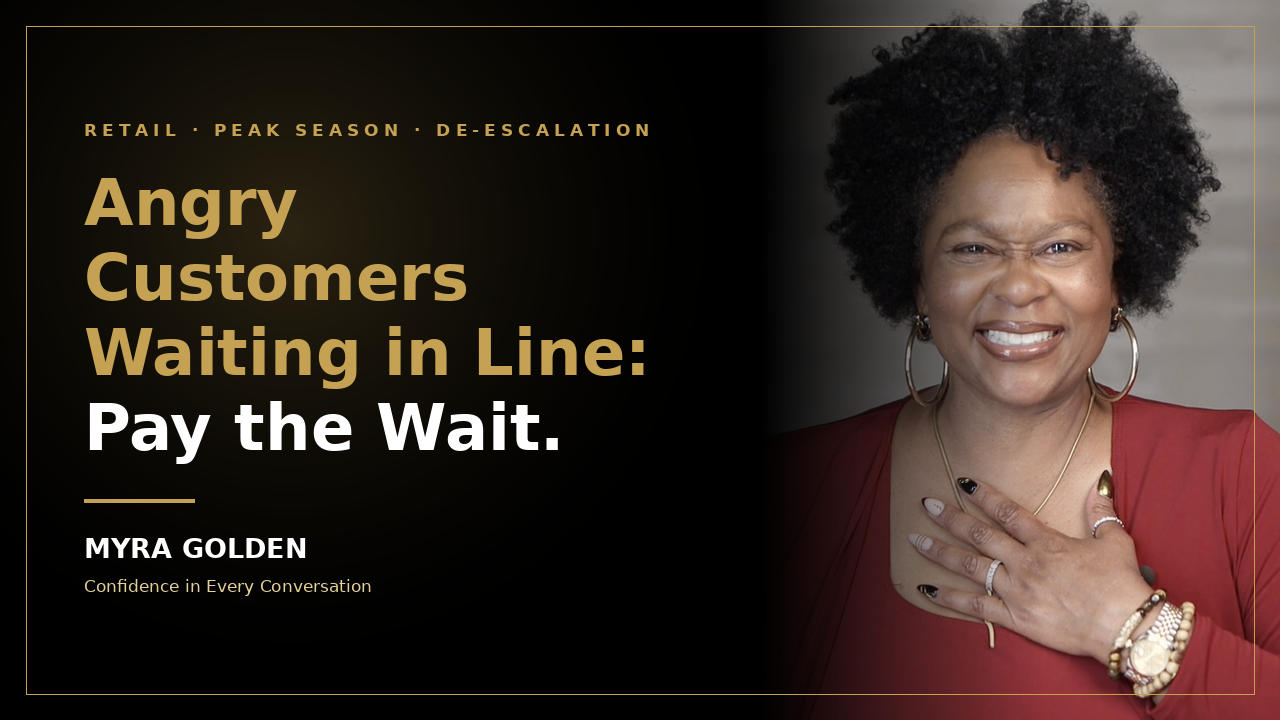
Angry Customers Waiting in Line: Pay the Wait.
● READ THIS BEFORE THE DOORS OPEN
Nobody in your line is mad at you yet. They're mad at the line. And in about four seconds, you're going to inherit it.
Handling angry customers waiting in line comes down to one sentence, said before the customer speaks. Every person who reaches a register in December arrives with a balance: fifteen minutes of standing, a parking lot, a kid pulling on her arm. I call it wait debt. Your job in the first sentence is to pay it before she has to collect. Three moves: Name it. Start it. Close it.
This is the third post in my peak-season series for store managers, assistant managers, and the trainers getting teams ready for Black Friday through January. The first, The Sidestep, is about taking away the customer's audience. The second, Show the Try, is about the ten seconds before every no. This one is about the four seconds before hello.
Want the exact words for the rest of peak season? My 57 Phrases for Handling Difficult Customers covers the no, the refund you cannot give, and the customer who will not stop. Get the 57 Phrases sent to you.
Here is the video version. This one is built for the Black Friday huddle.
● WHAT MOST PEOPLE DO
You say "Next." She says the wait.
Here is what happens at most registers. The associate says "Next." The customer steps up. And the first thing out of her mouth is, "I've been standing here for twenty minutes." Now the associate is on defense before anyone has said hello.
Once she has said it out loud, she has committed to it. She has publicly named a grievance, and now she has to defend it. Whatever she came in for, the return, the exchange, the gift card, now sits behind the complaint about the line. The whole transaction runs at a higher temperature because of a sentence that was completely predictable.
An unacknowledged wait becomes the first complaint, no matter what she came in for. Say it before she does, and it never becomes a complaint at all.

● THE SCIENCE
The psychology of waiting is really clear.
David Maister laid it out decades ago in The Psychology of Waiting Lines, and every study since has confirmed it. Waits before service starts feel longer than waits during service. Unexplained waits feel longer than explained ones. Anxious waits feel longer. Unfair waits feel longer, and a customer who has watched the other line move faster has been running that math the whole time.

Here is the part nobody teaches on the floor. All four of those get worse when the wait goes unacknowledged. The customer is not only tired of standing. She is waiting for somebody to notice that she stood. If nobody does, the noticing becomes her job, and she does it out loud.
● HERE'S THE MOVE
Wait debt, and how to pay it in one sentence.

Every customer who reaches you in December arrives with a balance. Fifteen minutes of standing. A parking lot. A kid pulling on her arm. That is wait debt, and the first sentence out of your mouth either pays it or hands her the bill. I call the move Pay the Wait. Three moves, one transaction.
1
Name it. Before she says a word about the line, you say it.
"I know that line was long. Thank you for hanging in there." Ten words. You just took her complaint and made it your acknowledgment. There is nothing left for her to collect. Notice it is a thank-you, not an apology. An apology invites a reply. A thank-you closes one.
2
Start it. Get the service moving in the same breath.
"Let's get you taken care of. What do you have for me?" The research is exact on this: waits before service feel longer than waits during service. The second she feels the service has started, the clock in her head slows down.
3
Close it. At the end, pay the last of the debt.
"Thanks again for the wait. I hope the rest of your day is easier than that line." That last line is the one she repeats in the parking lot, and it is the one that shows up in the review.

✖ NEVER THIS
"Sorry for the wait." It is not wrong, but it is weak. An apology asks her to respond, and the response is usually the complaint you were trying to prevent. "Thank you for hanging in there" gives her nothing to push against.
● SAY IT WITH ME
Pay the Wait, for four kinds of December lines.
THE LONG LINE
"I know that line was long. Thank you for hanging in there. Let's get you taken care of. What do you have for me?"
THE LINE THAT WASN'T THAT LONG
"Thanks for your patience today. Let's get you taken care of." Naming it first is the move, not the exact words. Match the size of the wait.
THE CUSTOMER WHO BEAT YOU TO IT
"You're right, and I'm glad you're at the front of it now. Let's make this part fast. What do you have for me?" She said it first. Agree, then start the service in the same breath.
THE CLOSE
"Thanks again for the wait. I hope the rest of your day is easier than that line."
Give your whole store Pay the Wait before Black Friday.
De-escalation Academy is the self-paced course your associates can finish in a lunch break, with the exact words for every hard moment in December.
● ONE THING FOR YOU, NOT FOR HER
You can't pay her wait if you never paid your own.
Eight hours of lines builds up in your body too. Between customers, one full exhale before you look up. That is the whole instruction. It takes two seconds, it costs nothing, and it is the difference between saying the ten words and meaning them. An associate who is running on the last customer's frustration cannot hand the next customer a clean start.
● MANAGERS, THIS IS YOUR HUDDLE
Ten words at the top of every transaction.
This is the Black Friday huddle. It is the most drillable thing in the whole peak-season series, because it is one sentence, said at the same moment, every time.
1
Play the video in the huddle.
Four minutes. Then say the three words back together: Name it, Start it, Close it.
2
Say the ten words out loud, together, three times.
"I know that line was long. Thank you for hanging in there." Out loud, as a group. It feels silly for about ten seconds and then it is in everyone's mouth.
3
Run one transaction at a live register.
One plays the customer who has been waiting, one plays the associate. The associate has to name the wait before the customer can. Ninety seconds, then switch.
4
Repeat it the Monday of Thanksgiving week.
Once now builds the habit. Once more in late November makes it the reflex your team reaches for when the line is out the door.
Drill it until it is the first thing your team says without thinking. That is the whole Black Friday huddle.
● WHAT PEOPLE ASK ME
Customers and long lines, the questions I get most.
How do you handle a customer who is angry about waiting in line?
Name the wait before she does. "I know that line was long. Thank you for hanging in there." Then start the service in the same breath: "Let's get you taken care of. What do you have for me?" An acknowledged wait rarely becomes a complaint. An unacknowledged one always does.
What should a cashier say to a customer who has been waiting a long time?
Ten words at the top of the transaction: "I know that line was long. Thank you for hanging in there." Use a thank-you, not an apology. An apology invites the customer to respond, and the response is usually the complaint. A thank-you closes the loop.
Why do customers get angrier waiting in a store than on hold?
Waits before service starts feel longer than waits during service, and a store line is all pre-service waiting. Add anxiety, a line next to hers that seems to move faster, and no explanation for the delay, and the wait feels far longer than the clock says. Maister documented all four effects in The Psychology of Waiting Lines.
How do you reduce wait time complaints during Black Friday?
You cannot shorten the line in the moment, but you can shorten how long it feels. Acknowledge the wait first, start service immediately, and thank her again at the end. Drill the ten-word opener in a huddle so every associate says it without thinking.
How do I train my retail team for peak season lines?
Two paths. De-escalation Academy is the self-paced course associates complete individually, with team licensing for stores and districts. For a private workshop built around your stores, your peak calendar, and your busiest register moments, work with me directly. I have trained retail teams at Walmart, Lands' End, Lowe's, and Limited Brands, and I spent eleven years on the floor myself.
Take the phrase bank with you. My 57 Phrases for Handling Difficult Customers is the full set, and it works at a register, on the phone, and in chat. Get the 57 Phrases sent to you.
Peak season is coming either way.
Walk into it with a team that knows exactly what to say in the first four seconds. De-escalation Academy, self-paced, with team licensing.
MYRA GOLDEN · CONFIDENCE IN EVERY CONVERSATION
Myra Golden's De-escalation Academy
A psychology-based system that helps professionals stay calm, redirect difficult conversations, and confidently resolve interactions—even when the answer is no.
Used by teams at Fortune 500 companies and NFL guest experience organizations.
Join Myra’s Inner Circle: Insights, Strategies, and Resources for Leaders Who Demand the Best.
Be the first to receive exclusive strategies, curated resources, and behind-the-scenes insights from Myra Golden—crafted for leaders who value excellence.
Your information will remain private and protected—always.
