
Retail De-escalation for Black Friday: The Sidestep
● READ THIS BEFORE THE DOORS OPEN
Nobody yells at an empty counter. The customer who lost it at your register last December was not only mad about the return. She had six people behind her watching, and once somebody has an audience, backing down feels like losing.
Retail de-escalation is the skill of calming an upset customer at the register, in front of other shoppers, when the answer is often no. It differs from phone de-escalation in one structural way: the customer has an audience. The technique that works removes that audience first, then separates the person from the policy, then hands her the last decision. I call it the Sidestep.
This post is for store managers, assistant managers, and the trainers who get their teams ready for Black Friday through the first week of January. Everything below is built to be read once, played in a huddle, and drilled at a register in ninety seconds.
Want the exact words for the rest of peak season? My 57 Phrases for Handling Difficult Customers covers the no, the refund you cannot give, and the customer who will not stop. Get the 57 Phrases sent to you.
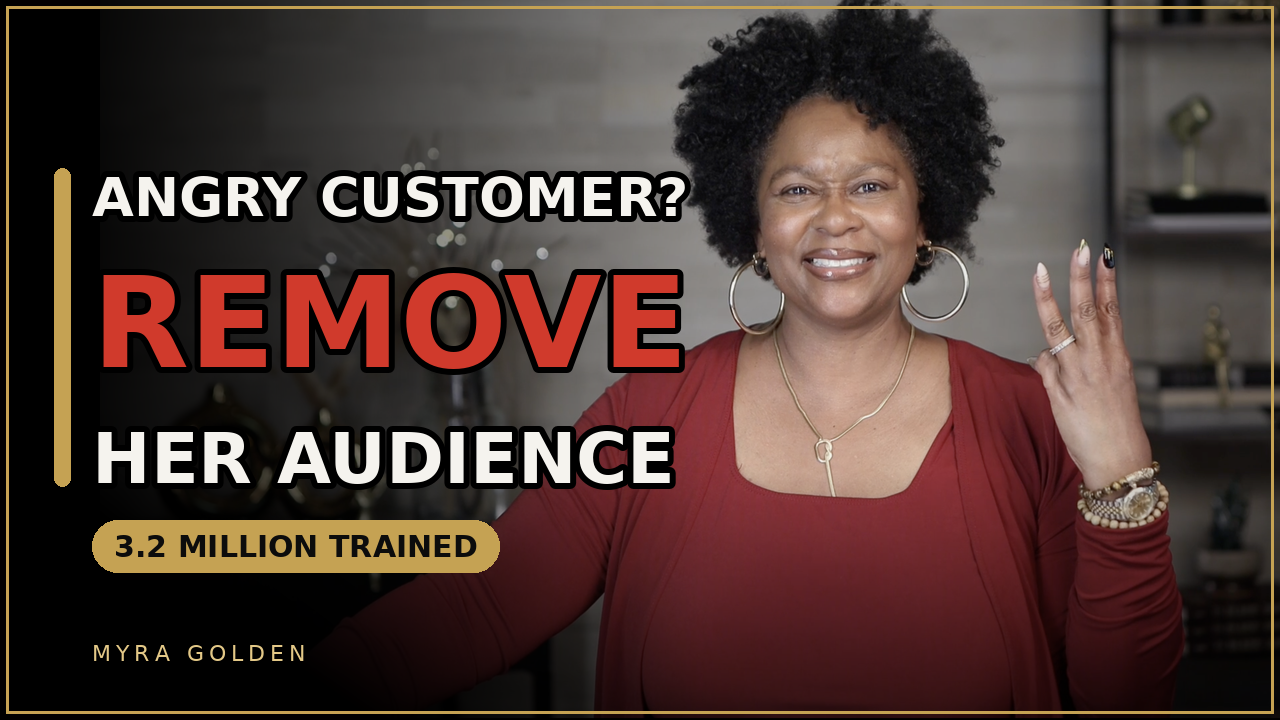
Here is the video version. If you are a manager, play it in your pre-shift huddle this week.
● THE PART MOST TRAINING MISSES
Call center de-escalation happens in private. Retail happens on a stage.
Almost every de-escalation script your team has ever learned was written for the phone. It assumes privacy. One person, one voice, a hold button, and a no that lands once before the call ends.
A register has none of that. The customer is standing three feet from the next customer. The people in line can hear every word. And she knows it. Sociologists call what happens next face-work: we protect our image hardest when strangers are watching. So in a store, you are never de-escalating one person. You are de-escalating a person and her audience.
Every escalation at a register is a performance, and the customer did not choose the audience. Your first job is to take the audience away.

This is why the usual advice fails in December. "Stay calm, apologize, listen" is fine, but it treats the register like a phone. It does nothing about the six future customers watching to see how this ends.
● WHY THIS SEASON IS HARDER
Peak season means more no answers, in front of more people than ever.
Returns have nearly doubled since 2019 and now run close to 16 percent of all retail sales. Two out of three retailers say updating their returns process is a priority this season, and three out of four expect return fraud to get worse during the holidays. The practical translation for the floor: tighter policies, more hard answers, and a longer line behind every one of them.

If you run a store for a membership or subscription brand, add one more layer. A large share of the people walking in are already members, and some of them arrive with a billing question, an expired credit, or a charge they never noticed. None of that happened in your store. Your associate cannot reverse it from the register. But your associate is the first human face that customer has seen, and that is where the anger lands.
Your team will say no more this December than in any December before it. The question is whether they say it with a witness or without one.
● HERE'S THE MOVE
The Sidestep: Step, Split, Steer.

The Sidestep is a three-move register technique that removes the customer's audience before you answer, separates her from the policy, and hands her the last decision. It works with any return policy, requires no authority your associate does not already have, and takes about ninety seconds to drill.
1
Step. Take away her audience.
The second the volume goes up, say "Come with me for a second," and take two steps to the side of the register. Not to an office. Two steps. If you cannot leave the register, turn your body toward her and drop your voice. Either way, the line is no longer the audience, and a customer with no audience has nothing to perform for. Watch what happens to her volume.
2
Split. Separate the person from the problem.
Say it out loud: "You didn't do anything wrong here." The gift with no receipt, the membership charge she never noticed, the credit that expired last week. None of that was a decision she made in your store. The moment you name it, she stops defending herself, and she can finally hear you.
3
Steer. Give her the last decision.
"Here's what I'm able to do today. I can exchange this for anything on the floor, or I can put the full amount on a gift card. Which one helps you more?" Even when the answer is not the one she came in for, the person who makes the last choice walks out feeling like she won something.

Notice what the Sidestep does not do. It does not override policy. It does not promise a refund. It does not require a manager. It changes the room, the framing, and who gets the final word, and those three things are what the customer actually remembers.
✖ NEVER THIS
"Unfortunately, I can't do that." The word unfortunately tells her a fight is coming, and "I can't" makes it personal. Say "I'm not able to," and say what you can do in the same breath.
● SAY IT WITH ME
The exact words, for the five hardest register moments this season.
THE GIFT WITH NO RECEIPT
"Come with me for a second. You didn't do anything wrong here, this one came without a receipt. What I'm able to do today is put the current value toward anything on the floor. Want to take a look?"
FINAL SALE
"Let me look at two things for you. This one was marked final sale, so I'm not able to refund it. What I can do is help you find the right size or an exchange. Which helps you more?"
THE RETURN WINDOW CLOSED
"The window on this closed on the ninth, so a refund isn't something I'm able to do. Here's what I can do: a store credit for the full amount, or an exchange today. Your call."
THE MEMBERSHIP CHARGE
"You didn't do anything wrong here. That charge came from the account online, and I'm not able to reverse it from this register. Here's exactly who can, and I'm going to write it down for you so you're not starting over."
THE CUSTOMER WHO IS STILL YELLING AFTER THE SIDESTEP
"I want to fix this with you. I can do that in a normal voice, and I'm going to stay right here until we're done."
Give your whole store the Sidestep before Black Friday.
De-escalation Academy is the self-paced course your associates can finish in a lunch break, with the exact words for every no.
● MANAGERS, THIS IS YOUR HUDDLE
The ninety-second drill that saves a whole season.
The Sidestep only works if the two steps are automatic. An associate who has to think about it under pressure will not do it. So the drill is physical, and it happens at the register, not in the break room.
1
Play the video in the huddle.
Three minutes. Then say the three words back together: Step, Split, Steer.
2
Pair up at a live register.
One plays the customer with a no-receipt gift, one plays the associate. The associate has to physically take the two steps and say the Split line before anything else. Ninety seconds, then switch.
3
Put the Steer line on the register.
Tape it where only your team can see it: "Here's what I'm able to do today." It is the cheapest de-escalation tool you will ever buy.
4
Repeat it Monday of Thanksgiving week.
Once in September builds the habit. Once more in late November makes it the reflex your team reaches for when the line is out the door.
You do not control the policy. You do control whether she leaves confident that somebody in that store was on her side. That is what brings her back in January.
● WHAT PEOPLE ASK ME
Retail de-escalation, the questions I get most.
How do you de-escalate an angry customer in a retail store?
Take away her audience first. Step to the side of the register, or turn your body and drop your voice. Then separate her from the policy with "You didn't do anything wrong here," and give her the last decision by offering two things you are able to do and asking which one helps more. That is the Sidestep.
What should retail employees say when a customer wants a refund without a receipt?
Do not lead with the policy. Lead with the person: "You didn't do anything wrong here, this one came without a receipt." Then offer what you can do, usually store credit or an exchange, and let the customer choose. A no that arrives with a choice attached feels like a decision she made, not a decision made against her.
Why is retail de-escalation different from call center de-escalation?
The audience. On the phone, the customer backs down in private. At a register, backing down happens in front of strangers, and that costs her face. Retail de-escalation has to remove the audience before any script will work.
How do you prepare retail staff for Black Friday and holiday returns?
Drill one technique, not ten. Play a short video in the huddle, pair associates at a live register for ninety seconds each, and repeat it the Monday of Thanksgiving week. The goal is a reflex, not a memory.
How do I train my whole retail team on de-escalation?
Two paths. De-escalation Academy is the self-paced course associates can complete individually, with team licensing for stores and districts. For a private workshop built around your policies, your busiest register moments, and your peak season calendar, work with me directly. I have trained retail teams at Walmart, Lands' End, Lowe's, and Limited Brands, and I spent eleven years on the floor myself.
Take the phrase bank with you. My 57 Phrases for Handling Difficult Customers is the full set, and it works at a register, on the phone, and in chat. Get the 57 Phrases sent to you.
Peak season is coming either way.
Walk into it with a team that knows exactly what to say when the answer is no. De-escalation Academy, self-paced, with team licensing.
MYRA GOLDEN · CONFIDENCE IN EVERY CONVERSATION
Myra Golden's De-escalation Academy
A psychology-based system that helps professionals stay calm, redirect difficult conversations, and confidently resolve interactions—even when the answer is no.
Used by teams at Fortune 500 companies and NFL guest experience organizations.
Join Myra’s Inner Circle: Insights, Strategies, and Resources for Leaders Who Demand the Best.
Be the first to receive exclusive strategies, curated resources, and behind-the-scenes insights from Myra Golden—crafted for leaders who value excellence.
Your information will remain private and protected—always.
