When You're About to Snap: How Leaders Use the 3R Method to Stay in Control

Picture this: you're in the middle of a heated email exchange with a client. Your jaw's clenched, your fingers are hovering over the keyboard, and you're crafting a response that's going to set the record straight once and for all. Sound familiar? Here's what I've learned after teaching de-escalation to over 2 million customer service professionals - the moment you feel that urge to defend, correct, or react is exactly when you need to pause.
Recently, I found myself in this exact situation. A B2B client relationship had become increasingly frustrating. Emails were piling up, small misunderstandings were turning into bigger problems, and I could feel that familiar emotional hijack starting to take over. You know the feeling - that fight-or-flight response that makes you want to fire off a quick reply to "clear things up."
But here's the thing about emotional hijack: it doesn't just happen to your customers. It happens to you too. And when you're the leader, when you're the one who's supposed to be guiding the conversation, that's when de-escalation skills become absolutely critical.
The 3R Method: Your Leadership De-escalation Toolkit
Over the years, I've developed what I call the 3R Method for managing emotional hijack - whether it's happening to you, your team, or your customers. It's not about being nicer or suppressing your feelings. It's about understanding the psychology of what happens when emotions spike and clarity drops.
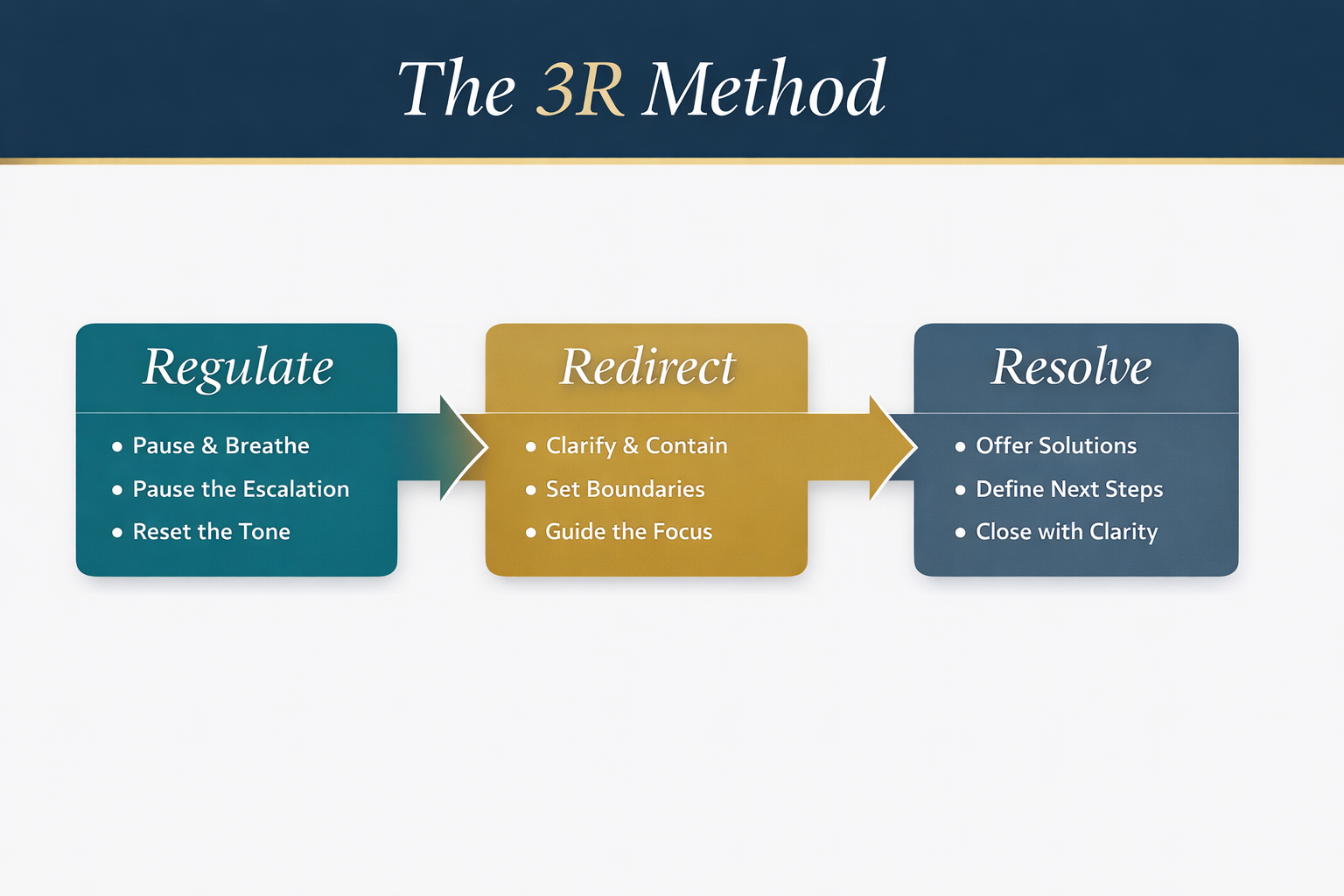
Step 1: Regulate Before You Respond
The first R is regulate, and it always starts internally. Before you can manage anyone else's emotions, you have to notice your own.
In my client situation, this meant pausing instead of firing off that defensive email. It meant acknowledging my frustration without acting from it. It meant giving myself space to come back into alignment with how I wanted to lead.
Regulation doesn't mean suppressing emotion - it means preventing emotion from running the conversation.
Once I was steady, I could regulate the conversation itself. I started my response with a simple, intentional line: "I want to pause the back and forth and clearly reset expectations so we can move forward cleanly."
That sentence wasn't about control. It was about nervous system stabilization. It signaled safety, structure, and leadership to everyone involved.
Later in the message, I reinforced that regulation by naming the emotional temperature without escalating it: "It's clear that there has been ongoing frustration, and my priority is to resolve this in a way that is clean and respectful for both of us."
This is what regulating others looks like at a leadership level. You don't tell people to calm down. You set a tone that makes escalation unnecessary.

Step 2: Redirect from Emotion to Clarity
Once regulated, the next step is redirect. Not redirecting the person - redirecting the conversation.
Instead of addressing every email thread, every perceived slight, or every point of friction, I asked a different question: "What does clarity look like here?"
The answer wasn't another explanation. It was a reset. Clear facts, clear expectations, clear next steps. No defensiveness, no over-apologizing, no emotional leakage. Just a calm, structured response that replaced confusion with order.
When you redirect effectively, you're pulling the conversation out of the emotional weeds and back onto solid ground. You're creating space for real problem-solving to happen.
Step 3: Resolve with Dignity and Boundaries
The final R is resolve. This is where many leaders struggle - not because they don't know what to say, but because they fear what resolution might cost them.
Here's what I want you to understand: resolve doesn't mean pleasing everyone. Resolve means closing the loop with dignity.
In my client situation, resolution meant:
- Acknowledging a possible mistake without weakening my authority
- Restating the correct process clearly
- Offering a clear path forward
- Providing a clean exit option
Resolution restores control - not through force, but through structure.
Why De-escalation is Actually Leadership
This experience reminded me of something I teach teams every day: de-escalation is not passive. It's leadership.
It's the ability to pull yourself out of emotional hijack, replace friction with clarity, set boundaries without hostility, and guide conversations to a clean close.
Whether you're handling an upset customer, a stressed team member, or a tense client relationship, the principles are the same:
- Calm first
- Clarity next
- Resolution last
That's how conversations de-escalate. And that's how leaders stay in control without escalating themselves.
Putting the 3R Method Into Practice
The next time you feel that familiar tightness in your chest during a difficult conversation, remember the three Rs:
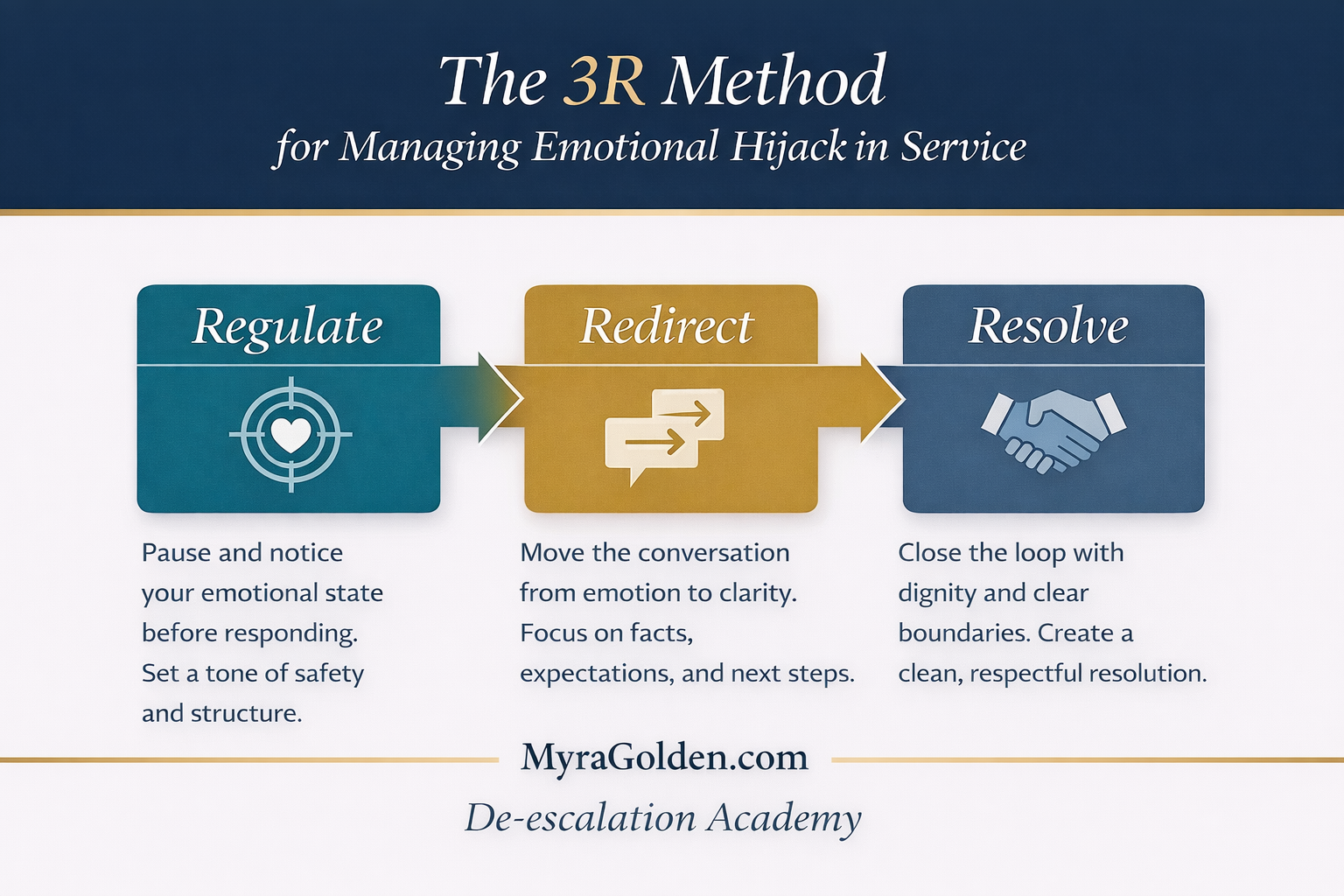
Regulate: Notice your emotional state and create space before responding. Set a tone that signals safety and structure.
Redirect: Move the conversation from emotion to clarity. Focus on facts, expectations, and next steps rather than getting pulled into the weeds.
Resolve: Close the loop with dignity and clear boundaries. Don't aim to please everyone - aim to create a clean, respectful resolution.
Remember, emotional hijack doesn't discriminate. It can happen to anyone at any level. But when you have the tools to recognize it and respond effectively, you're not just preventing escalation - you're modeling the kind of leadership that creates better experiences for everyone involved.
The 3R Method isn't just about managing difficult conversations. It's about staying grounded when the pressure's on, maintaining your authority without becoming defensive, and leading through clarity instead of emotion.
Your team is watching how you handle these moments. Your customers are feeling the energy you bring to challenging situations. Make sure what they see and feel is the calm, confident leadership that comes from mastering your own emotional regulation first.
Leader Takeaways
If you lead people, clients, or high-stakes conversations, here are three lessons worth carrying forward:
1. Regulate yourself before you regulate the situation.
If you feel the urge to over-explain, defend, or react, pause. Regulation isn’t weakness—it’s leadership discipline.
2. Redirect conversations toward structure, not emotion.
Clarity de-escalates faster than reassurance. Replace back-and-forth with clear facts, expectations, and next steps.
3. Resolution requires boundaries, not agreement.
You don’t need buy-in to resolve a situation. You need a dignified close that restores order and preserves trust.
This is the work I teach inside De-escalation Academy—not just for frontline teams, but for leaders who want to stay steady, clear, and in control when conversations get hard.
If this way of thinking about conversations resonates with you, this is the work we do inside the 3R De-escalation Operating System™.
It’s not scripts.
It’s not personality-based coaching.
It’s a repeatable system leaders install so difficult conversations don’t spiral—whether they happen with customers, employees, or clients.
Learn more about the 3R Operating System and how it installs calm, clarity, and control at scale inside De-escalation Academy.
Myra Golden's De-escalation Academy
A psychology-based system that helps professionals stay calm, redirect difficult conversations, and confidently resolve interactions—even when the answer is no.
Used by teams at Fortune 500 companies and NFL guest experience organizations.
Join Myra’s Inner Circle: Insights, Strategies, and Resources for Leaders Who Demand the Best.
Be the first to receive exclusive strategies, curated resources, and behind-the-scenes insights from Myra Golden—crafted for leaders who value excellence.
Your information will remain private and protected—always.
