Call enter De-escalation Techniques
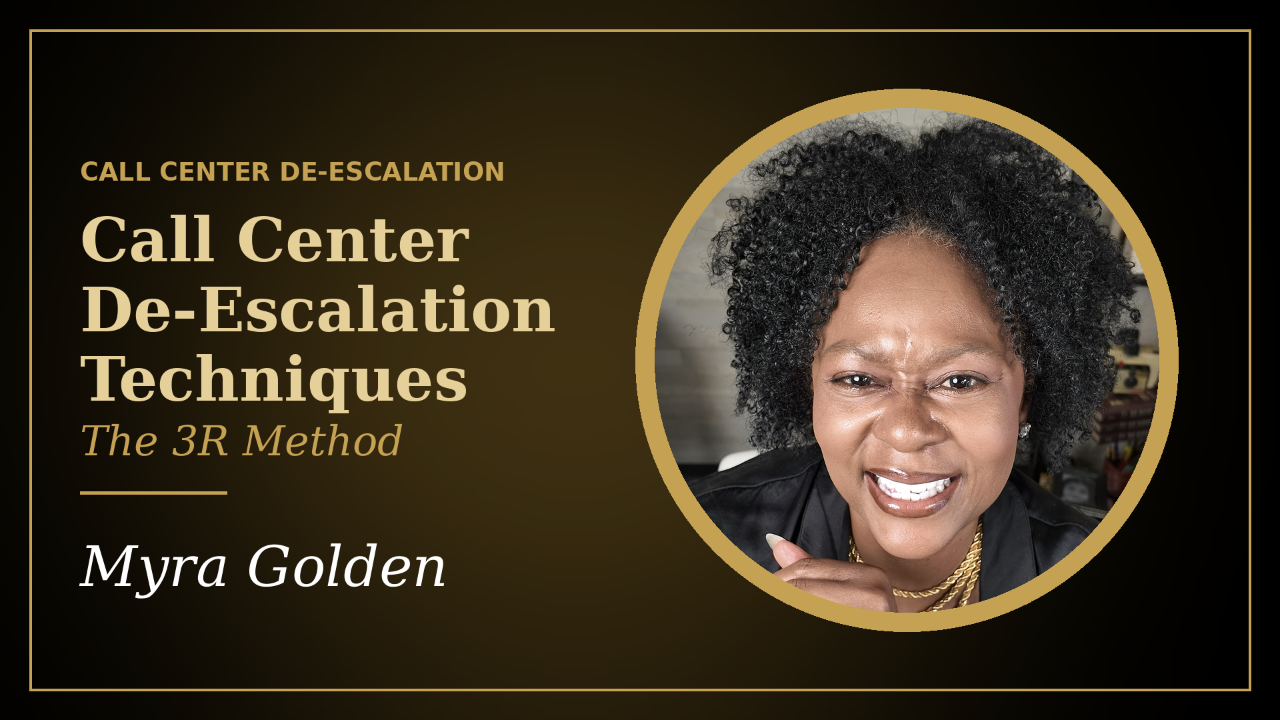
It is the call you brace for. The customer is shouting before you finish your greeting, the words are sharp and personal, and every instinct says defend yourself or rush to a fix. In a call center, that moment decides the entire interaction. De-escalation is the skill that turns it around, and it is not about gritting your teeth and hoping the storm passes. It is a sequence you run on purpose, on every call.
I have taught call center and customer service teams to de-escalate for over twenty years, more than three million customer-facing professionals inside some of the most demanding contact centers in the world. Everything I teach runs on one system, the 3R Conversation Control Method™: Regulate the emotion, Redirect the energy, Resolve the loop. This guide gives you the techniques, the word-for-word scripts, and the exact phrases that calm an angry customer on the phone, in live chat, and over email.
Want the exact words to take into your next call? Grab my free 57 Phrases That Calm Upset Customers, and put them to work today.
Why de-escalation is the most important call center skill
The hardest part of a call center job was never the technical problem. It is the emotion attached to it. A customer who feels unheard, overcharged, or jerked around does not call to have a calm conversation. They call hot. And when emotion is high, logic does not land. You can have the perfect solution ready and the customer will not be able to hear a word of it, because they are not in the part of the brain that processes solutions yet.
That is why de-escalation comes first, before troubleshooting, before policy, before the fix. It is also what protects you. Agents do not burn out from solving problems. They burn out from absorbing anger all day with no way to put it down. De-escalation is how you stop taking the full blast of every call, so the work stays about the issue and not the person's rage.
The mistake that makes an angry customer angrier
Telling an upset customer to "calm down" backfires every time. It triggers what psychologists call the reactance effect, the instinct to push back hard the moment someone feels their control or their feelings are being dismissed. The same is true of a handful of words that sound harmless but crack the door right back open. Keep these out of every call, every chat, and every email:
Never say: "Calm down." | "Unfortunately." | "There's nothing we can do." | "Per our policy." | "Sorry to inform you."
Every one of these tells the customer the wall is up and the conversation is over. The 3R Method replaces all of them with language that lowers the temperature and keeps you in control.
The 3R Method: a de-escalation technique for every call
Most de-escalation advice is a pile of tips with no order. The 3R Conversation Control Method™ gives you a sequence, so you always know what to do next no matter how the customer comes at you. Three steps, in this order, every time.
Regulate
Bring the emotional temperature down in the first ten seconds, before you touch the problem. You cannot reason with someone who is in fight-or-flight. First you make it safe.
Redirect
Move the energy forward without confronting the anger head-on. Break the repetition loop and lead the customer into a constructive space.
Resolve
Close the loop with clarity and confidence, even when the answer is no, so the customer leaves with a clear next step instead of a reason to fight again.
Step 1, Regulate: calm the customer in the first 10 seconds
Here is something I love from the animal world. When two chimpanzees fight and one is losing badly, that chimp has one last move that can save his life. He grabs a baby chimp, it does not matter whose, and holds it up to the face of the alpha. And the alpha comes down. The aggression drains out of him in an instant. Scientists call it the Baby Chimp Effect. The problem is not solved. The temperature simply drops, and the brain shifts out of attack mode.
An empathy statement is your verbal baby chimp. It interrupts the emotion long enough for the customer to come back to a place where they can actually hear you. So before you explain, before you fix, before you say no, name what the customer is feeling. Say the feeling first. These are the lines that do it:
01 "I realize how frustrating this must be for you."
02 "I can hear that this is frustrating. Let's slow this down and take it one step at a time."
03 "It sounds like this has been a really challenging situation. Let's see what we can do right now."
04 "I'd feel the same way in your shoes. Let me take a look at this with you."
On the phone, your voice carries the regulate move. Slow down, stay warm, and keep your pace even. If the customer speeds up, you slow down. If they get louder, you stay steady. In live chat you lose your voice, so the words have to do more work. Lead with the feeling, use the customer's name, and keep your lines short. Then, and only then, move forward. Validate, then progress. Never leave the customer parked in the feeling.
Step 2, Redirect: move the energy forward
Some customers push back no matter what. Even when they feel heard, even when you stay calm, they keep circling the same complaint. Redirecting means moving the energy forward without meeting the anger head-on. Two techniques do the heavy lifting.
Move the Bed. A hospice nurse once had a patient who refused to get into bed because she was convinced her room was on fire. The nurse tried logic. She tried reassurance. Nothing worked. Her supervisor asked, "Would you climb into bed in a room that was on fire?" The nurse said no. "Neither will your patient. You are going to have to move the bed." So they did, and the woman got into bed. You do not win by arguing the customer out of how they see it. You meet them inside their reality and move things forward from there.
Get Off the X. When a customer yells or curses, it can feel like standing in front of a fire hose. In the Secret Service, the exposed spot where the threat hits is called the X, and agents are trained to move off it immediately. In customer service, the X is the moment the customer crosses the line. You do not stand in it. You acknowledge without absorbing, redirect with authority, and when you have to, set a calm boundary. Here are the words, ready to say:
Acknowledge without absorbing: "I am happy to help you, and I ask that you speak to me respectfully so I can."
Redirect with authority: "Let's focus on the solution we can move forward with right now."
Set a boundary: "I'm sorry, I can't help while being spoken to that way. The moment it stops, I'm right here to help."
Notice what these do. They name the frustration without taking the attack personally, and they keep pointing back at the fix. That is how you stay in control of a call that is trying to pull you into a fight.
Step 3, Resolve: close with confidence, even when the answer is no
The hardest part of many calls is the no. Most agents soften it until it falls apart. They say "unfortunately," they over-explain, they leave the door halfway open, and the customer pushes right back through it. I teach the Two Doors Method instead.
Picture two doors in front of the customer. One says NO. One says NEXT STEP. When the answer is no, you close the NO door cleanly, without defending policy or over-explaining, because the more you defend, the more you invite debate. Then you point to the other door and give the customer a real path forward.
Close the NO door: "We're not able to issue a refund for that order."
Open the NEXT STEP door: "Here is what I can do. I can apply a credit to your next statement today, and I'll stay on with you until it's confirmed."
The answer to the request is still no. But the conversation is not over, and the customer has somewhere to go besides back into the fight. That is what confident resolution sounds like.
De-escalation scripts for common call center calls
Here is the 3R Method running on the calls your team takes every day.
The overcharge. The customer was billed more than they owed and they are furious.
"I realize how frustrating it is to see a charge that's higher than you expected, and I'd want it fixed fast too. Let's look at it together right now. I see the overcharge here, and what I can do is reverse it today and send you confirmation before we hang up."
The cancellation. The customer wants to cancel and is venting on the way out.
"It sounds like this hasn't worked the way you hoped, and I don't blame you for being done with it. I'll take care of the cancellation for you. Before I do, here's the one thing I can offer that might change the math for you, and if it doesn't, I'll still cancel today, no runaround."
The second agent. You are the second person they have reached, and they think the first one was useless.
"Having to explain this twice is exhausting, and you shouldn't have to. Thank you for walking me through it again. I've got it now, and I'm going to stay with it until it's handled."
The outage rush. A service outage has the lines flooded with the same complaint.
"You're right to be frustrated, and you're not alone, we're seeing this in your area and the team is on it. Here's exactly what I can tell you about the timeline, and here's how I'll make sure you get the update the moment it's resolved."
Install the 3R Conversation Control Method™ in your team
Give your call center agents the training that turns the hardest calls into the ones they handle with confidence, on the phone, in chat, and over email.
Confidence in Every Conversation.
De-escalation phrases that work, and the ones to never use
Keep this list close. The left column lowers the temperature. The right column raises it. Train your team to swap one for the other on instinct.
Say this: "I realize how frustrating this must be." → Not this: "Calm down."
Say this: "Here's what I can do." → Not this: "There's nothing we can do."
Say this: "Let's look at this together." → Not this: "That's just our policy."
Say this: "I'll stay with this until it's handled." → Not this: "Unfortunately."
Protect your own mental health between calls
De-escalation is not only about the customer. The agents who last are the ones who learn to put the call down when it ends, instead of carrying the anger into the next one. A customer's rage is almost never about you. It is about a bill, a broken product, a hard week. When you regulate the customer, you also regulate yourself, because you are no longer standing in the fire hose taking the full blast. That is how you protect your focus, your composure, and your career in a job that hands you all the blame and none of the thanks.
Frequently asked questions
What are de-escalation techniques in a call center?
De-escalation techniques are the moves that lower a customer's emotional intensity so you can solve the problem. The most reliable approach is a sequence, not a pile of tips. My 3R Conversation Control Method™ runs it in three steps: Regulate the emotion in the first ten seconds, Redirect the energy forward, and Resolve the loop with a clear next step.
How do you de-escalate an angry customer on the phone?
Lead with a calm, even voice and an empathy statement that names the feeling, such as "I realize how frustrating this must be." Slow your pace, use the customer's name, and resist the urge to defend or explain until the temperature drops. Then move to the fix and end with one clear next step.
What should you not say to an angry customer?
Avoid "calm down," "unfortunately," "there's nothing we can do," "per our policy," and "sorry to inform you." Each one signals the wall is up and triggers more pushback. Replace them with what you can do and a real path forward.
How do you handle a customer who is yelling or cursing?
Get off the X. Acknowledge the frustration without absorbing the attack, redirect to the solution, and if it continues, set a calm boundary: "I'm happy to help, and I need us to keep this respectful so I can." You are not required to absorb abuse to do your job.
How do you say no without escalating the customer?
Use the Two Doors Method. Close the NO door clearly and without over-explaining, then open a NEXT STEP door with something you can do and a real timeframe. The answer stays no, but the customer has a path forward instead of a reason to keep fighting.
What is the difference between de-escalation and conflict resolution?
De-escalation lowers the emotional intensity so a conversation becomes possible. Conflict resolution solves the underlying issue. You almost always have to de-escalate first, because a customer in fight-or-flight cannot process a solution until the emotion comes down.
57 Phrases That Calm Upset Customers
The exact, sayable lines my clients use to de-escalate on the phone, in chat, and over email. Get the PDF sent straight to you.
Myra Golden's De-escalation Academy
A psychology-based system that helps professionals stay calm, redirect difficult conversations, and confidently resolve interactions—even when the answer is no.
Used by teams at Fortune 500 companies and NFL guest experience organizations.
Join Myra’s Inner Circle: Insights, Strategies, and Resources for Leaders Who Demand the Best.
Be the first to receive exclusive strategies, curated resources, and behind-the-scenes insights from Myra Golden—crafted for leaders who value excellence.
Your information will remain private and protected—always.
